
Legend of the Galactic Heroe
[Author: Angelo Cao]
“In every time, in every place, the deeds of men remain the same".

Legend of the Galactic Heroes (aka LoGH) is a series of OVA released in 1988-1997. This 110-episode story adapts novels written by Yoshiki Tanaka in the 1980s, who is also the author of The Heroic Legend of Arslan.
LoGH is a science fiction anime staged in a distant future (around 3200 AD) in a universe far from Earth. As the title suggests, it tells the story of the rise of two heroes: on one side is the brilliant commander Reinhard von Lohengramm, who is climbing the aristocratic hierarchy of the Galactic Empire; on the other is the reserved historian Yang Wenli, who commands a fleet in the democratic Free Planets Alliance.
In this article, I wish to review this work by highlighting a few elements that, in my opinion, make LoGH unique and unparalleled in the anime (and cultural) industry, even 20 years after its conclusion. There will be no major spoilers, as my intention is to give readers a taste of the greatness of this masterpiece, which cannot be fully conveyed in a simple web review.
Two Nations, Two Heroes, Two Ideologies
“Perhaps in this universe, there exists a solitary, absolute truth. Perhaps it clarifies every question. But that's beyond the reach of these short hands.”
Yang Wen-li
It is impossible to review LoGH without mentioning the two heroes, Reinhard and Yang. This is not merely because they are the protagonists, but because they serve as the means through which the author conveys his reflections. They embody two conflicting values and ideals that transcend the bleed and warfare.
Reinhard von Lohengramm – born Reinhard von Musel - was the son of a low-ranking noble in the Galactic Empire. As a child, he endured the loss of his older sister, Annerose, when his father accepted to offer her as a concubine to Emperor Kaiser Friedrich IV in exchange for a large sum of money. Heartbroken by this loss, Reinhard vowed to rescue his sister and overthrow the corrupt aristocracy.

The Galactic Empire is an old-fashioned autocratic monarchy ruled by the Goldenbaum Dynasty for over five centuries. It was founded on the ashes of the Galactic Federation after a coup led by Federal President Rudolf von Goldenbaum, who dissolved the Parliament and declared himself Emperor. In fact, Rudolf is constantly remembered throughout the series as a violent tyrant who destroyed freedom and democracy - his name itself, “Rudolf,” evokes historical associations with Adolf Hitler. The Germanic names, Gothic palaces, and the black-uniformed army - often accompanied by epic music from German composers (Wagner, Strauss etc.) - suggest an aesthetic inspired by 19th-century Prussian militarism.

Reinhard deeply disdain the current feudalistic system in which aristocratic privilege overrides merit, and the pride and selfishness of the parasitic noble class overshadow the welfare of the people and the nation. His ambition is to dismantle this corrupt, oppressive system, unify the galaxy, and liberate humanity.

Yang Wenli was born into a middle-class merchant family in the Free Planets Alliance. From a young age, he showed a strong interest in history. But after his father’s death, he felt into poverty, and he reluctantly joined the military as a means to continue his education. He neither desired war nor wanted to be directly involved in the conflict with the Empire—yet his extraordinary military talent and intelligence allowed him to quickly rise through the ranks, eventually becoming the commander of the 13th Fleet. His brilliance on the battlefield earned him titles like “Magician” and “Miracle Yang.”

The Free Planets Alliance was born from the escape of a group of serfs fleeing Imperial territory. After traveling thousands of light-years through unknown space, they eventually found a habitable planet where they established a new nation. The Alliance is found on strong democratic and republican ideals, rejecting the dictatorship of the Goldenbaum dynasty: his citizens proudly uphold freedom of speech and policy, as well as diversity and equality for all. These values are reflected in the people and cities of the Alliance, which are more ethnically heterogeneous, international, and modern.

However, after centuries of war with the Empire, the Alliance gradually adopts a more militaristic stance, leading to corruption within the government. Democratic values become a mere tool of propaganda, enabling politicians to maintain their power and benefit from the ongoing conflict. This facade hides the fragility of a system increasingly incapable of standing up to the well-organized Empire.

LoGH presents the historical conflict between Democracy and Totalitarianism in an unconventional way, highlighting first of all the internal weaknesses and contradictions that erode both systems from within. Unlike the “Star Wars” saga, where the Republic symbolizes the "Good" destined to triumph over the "Evil" Empire, here the setting is much more morally complex that viewers struggle to determine what, or who, represents "Right."
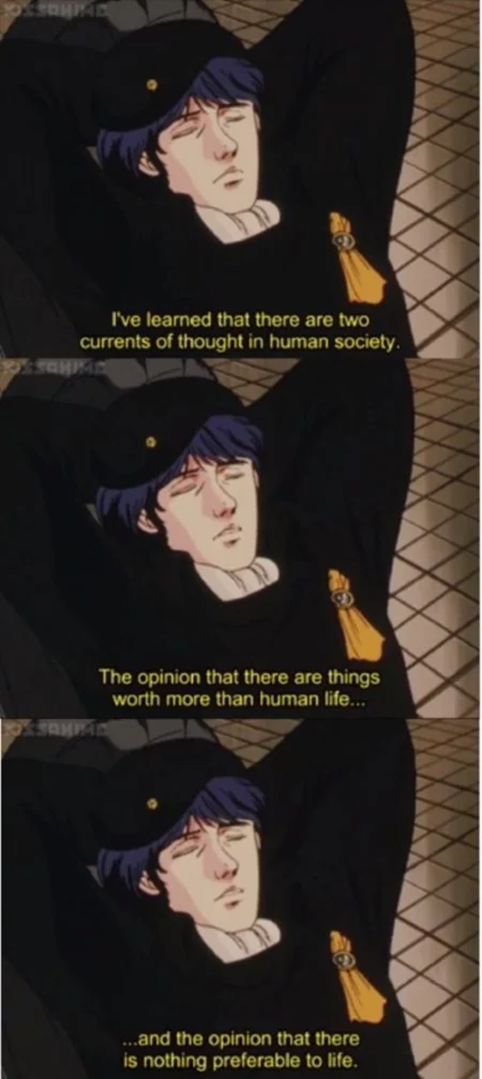
Both Reinhard and Yang tried to answer to this political and philosophical question.
On one side, there is the benevolent "Enlightened Prince" Reinhard, who is capable to rule the country with wisdom. His ambition is a healthy one, driven by a desire to save humanity from injustice and oppression. The contradictions within democracy justify his actions: people repeatedly elect politicians who claim to act for the selfish purposes. In fact, it was the right to vote that allowed Rudolf von Goldenbaum to seize power.
On the other side, Yang is a loyal believer in democratic values. Democracy can be inefficient, even hypocritical, but only in a democratic society people can live freely and fully. People may make mistakes - some may even be fatal, like electing Rudolf - but they can remain responsible for their choices, in contrast to a paternalistic autocracy where citizens submit passively to rulers, and those rulers may be corrupt or even criminal. In fact, nothing would prevent one of Reinhard's successors from becoming a second Rudolf.

The two Heroes represents the crush of two irreconcilable values. Reinhard believes in power and order to maintain justice within the society. Yang believes in freedom and peace, which are true elements that make individual life worthwhile and meaningful. Yet what unites them is their shared desire to save humanity from this historical crisis. This is why they are worthy of being called "Heroes."
The Legend, or the History
“For as long as human history goes on, the past will continue to accumulate. History isn't just records of the past. It's also proof that civilization has continued to advance to the present. Our present civilization is the result of our past.”
Yang Wenli
At this point, I hope the reader might agree with me in classifying LoGH as both science and historical fiction. Although set in a futuristic era, distant from us in both space and time, its vivid and realistic portrayal of future societies grants it a unique historiographical value. From another perspective, LoGH can be seen as a futuristic projection of past and present human history.
But what makes LoGH “historical” fiction goes beyond warfare and ideological conflict. Alongside the two Heroes and other protagonists, there is another “character” actively shaping the plot: History. In fact, LoGH address a Hegelian question throughout the whole series: are Heroes the drivers of History, or is it History that drives people?
Undoubtedly, Reinhard and Yang are heroes who have made history through deeds that ordinary people could not achieve. Yet can we truly say that, through their brilliance and charisma, they successfully changed human history? Or were they “pawns” created by a larger process or entity that transcends human control?

History in LoGH is portrayed as a cruel and relentless force, that no mortal is able to tame, and always ready to eliminate any obstacle in its path. Alongside the heroes, LoGH also presents “tragic heroes” who are brave enough to defy History, despite knowing the tragic fate that awaits them. In History, people are born, and people die, as well as societies, nations, and heroes: this is an eternal cycle from which humanity cannot escape, explaining the recurring deeds, events, and wars that persist, whether humanity wields swords, guns, or travels through space. This is why, although set in a distant future, every event in LoGH feels surprisingly natural and familiar, because, in the face of History, time and space become irrelevant dimensions.

Yet, LoGH does not present History as a force humanity must simply resign to. Instead, it gives us heroes who, at the very least, aspire to greatness. Most importantly, all heroes seek to end the cycle of warfare that has plagued humanity. Their methods may differ, and peace may be a historically contingent, but it remains the one thing that can bring to humanity hope for life. Though they may be part of a larger cycle, History rewards such heroes by remembering them after death - as Legends.

Legend of the Galactic Heroes is a story-heavy anime, primarily driven by dialogue and the self-reflection of its characters. Animations and visuals are not the central focus of this anime, which might be a drawback for some viewers. In general, the storytelling pace can be too slow for someone, but it is needed to allow more depth in character interactions and development.
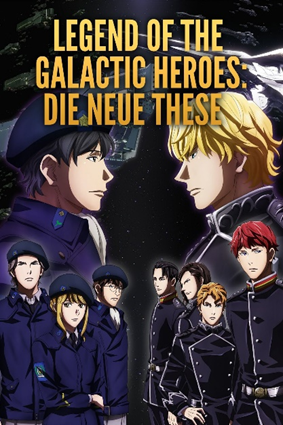
If you’re not a fan of the older design and animation style, there’s a new version, Legend of the Galactic Heroes: Die Neue These, which is currently remaking the entire series. I’ve only watched the first season (in fact, it was Die Neue These that led me to watch the original), so I can’t speak much about the remake as a whole, except that the new character-design tried to “idolize” the aesthetics of the protagonists.
However, if you feel to be really into those philosophical & political themes, I hope this review has made the anime sound interesting to you.


Comments